- More
-
-
-
 Recipes
Larch-cured smoked trout with buckwheat blinis and lemon crème fraîche
By Fieldsports Journal
-

-
- No posts selected.
-
-
-

- More
-
-
-
Recipes
Larch-cured smoked trout with buckwheat blinis and lemon crème fraîche
By Fieldsports Journal
-
-
- No posts selected.
-
-
-

Old age and character
Dr Kevin ‘Doctari’ Robertson, a qualified veterinarian and respected authority on African wildlife management and conservation, explains the controversial topic of what constitutes a trophy specimen.
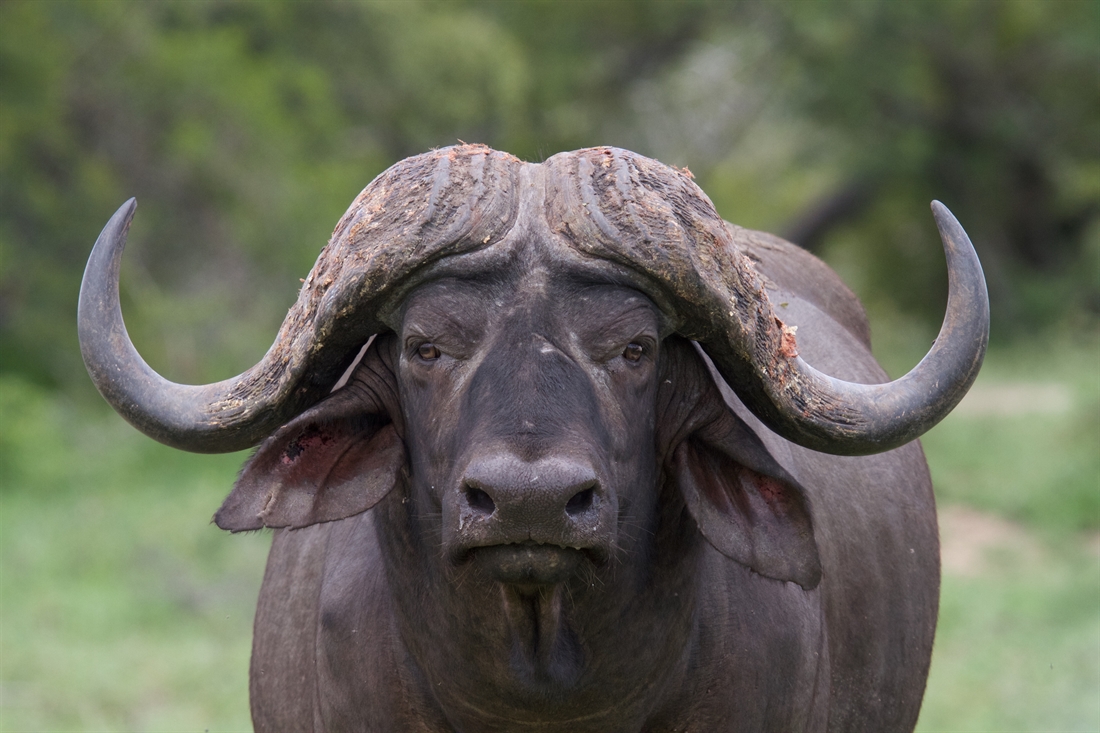

There are many interpretations to the term ‘trophy’. Regardless of species, my personal opinion on this somewhat controversial topic is that a trophy should be a life-long reminder of the experience, in all its forms, of the occasion when that particular animal was hunted. Knowing that such an animal had every opportunity to have enjoyed a full, reproductively successful life should make the occasion a lot more meaningful. Sadly, far too many judge a trophy exclusively on its ranking in the record book, with little or no thought spared about the sustainability of their actions.
With regards to Safari Club International’s (SCI) trophy measuring system, and as previously explained, a cape or southern bull buffalo scores his greatest during his seventh year, the time when this age class of bulls vigorously begin to horn rub in preparation for the fights so necessary for social dominance and, ultimately, breeding favours. It should be easy to realise that the continual shooting of the best trophy specimens before they have had the opportunity to mature further and breed, is simply not sustainable from a genetic perspective. A quick review of the top-ranking bulls in the SCI record book will soon reveal their individual ages. Sadly the majority were all of pre-breeding age, which when you really think about it is shocking.
Regarding the various buffalo species, a 40″ outside horn spread size has long been the holy grail for the majority of trophy hunters. Such a spread size is easy to recognise whenever a buffalo looks at you, as they so often do, with their noses uplifted and that well-documented look of ‘hate’ or ‘you owe me money’ in their eyes. This is because the outside spread width of a bull buffalo’s alert and pricked ears is between 32-33″. In Africa, distance is measured by hours of travel. In a similar fashion the human hand is used as a measure length. Our hands are about 4″ wide and 6″ long. A classic example of how an African PH would use this terminology would be something like this, “shoot the leopard in the middle of the body, a hand’s width behind the armpit crease”.
Given that the straight-line, ear-tip to ear-tip measurement on a bull buffalo is about 32″, it is easy to estimate outside horn spread length. Fortyinchers are bulls where it is possible to imagine fitting a hand’s width on either side of the ear tips to reach the outer edge of the bull’s spread. In a similar fashion, with impressively wide-spreading bulls it is possible to fit two hand widths on either side of the ears, putting such bull’s horns into the 47-48″ spread bracket.
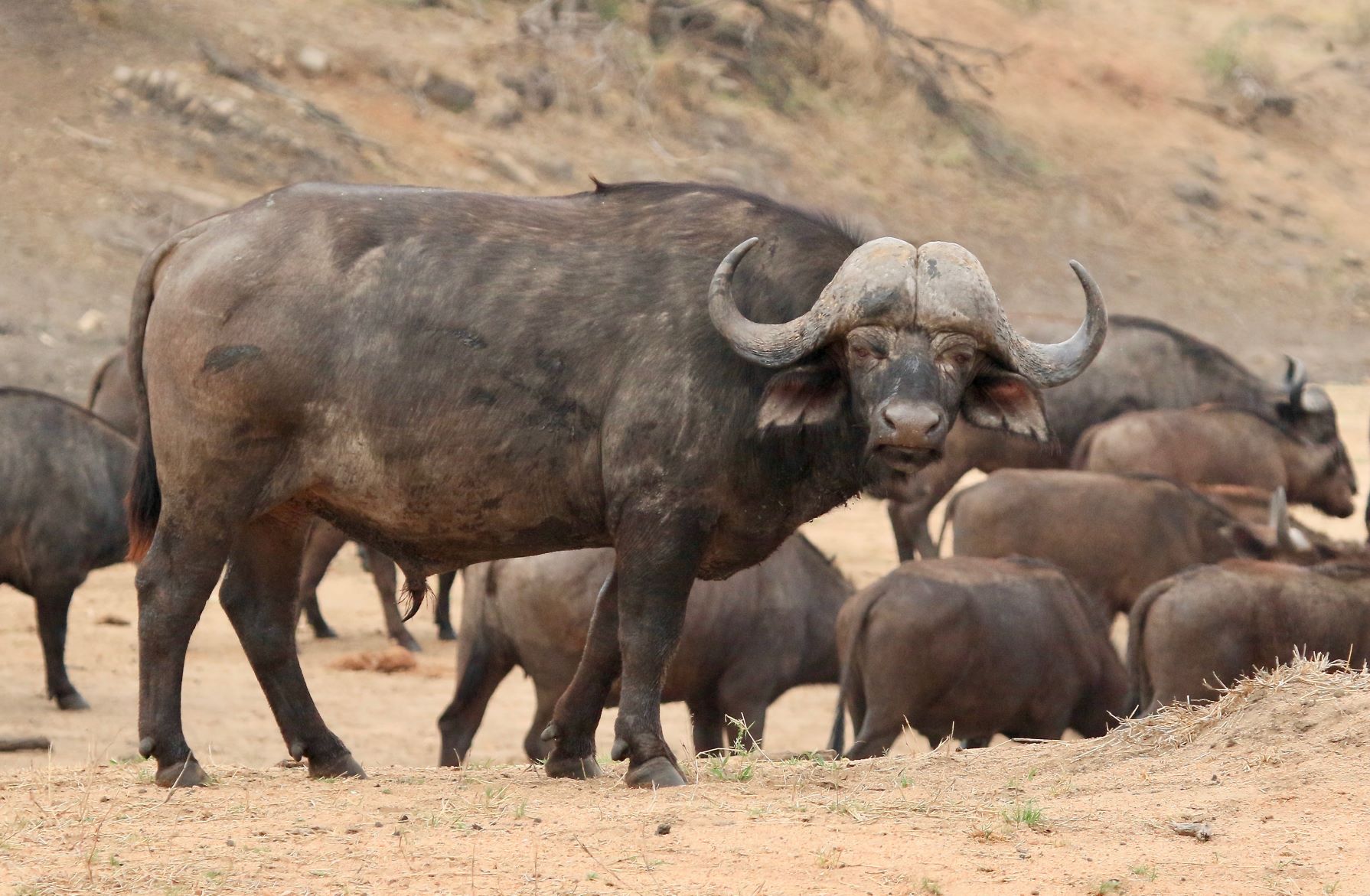
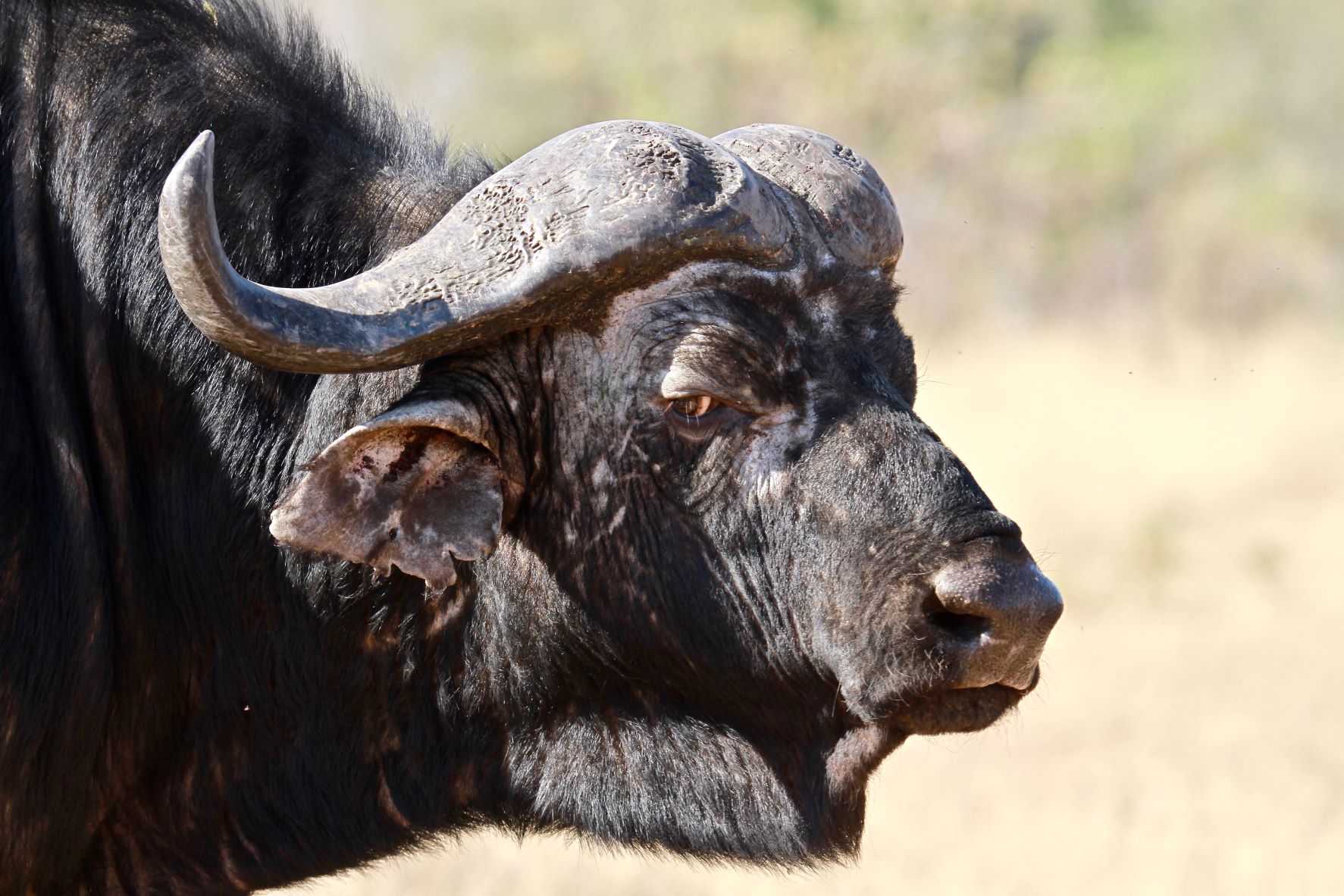
A sexually mature buffalo’s age can be accurately estimated by the degree of boss hardness, the condition and position of the horn tips, overall skin colour, the condition of the ears, the size of the chinlap, and the degree of muscling in the neck and shoulder region. White facial marking, as a result of mite infestations, are also a good indicator of advanced age.
South of the Zambezi River in areas which obtain 400-650mm of annual rainfall, free ranging male buffalo become sexually mature sometime in their fifth year. This is when they attain two-thirds of their mature, genetically determined body weight. At this age such bulls still look young, with their coat colour being brown. Another two years or so will be needed for them to mature and start muscling up, while the boss slowly hardens. By sometime in their eighth year, the top of a bull’s boss will have hardened sufficiently to withstand the sometime violent bouts of head butting associated with fights for social dominance. The lower frontal edge of the boss towards the central midline is the last to harden and by this age there often remains a degree of puffiness to this area. This fact makes it easy to age such bulls, as does their by now black skin colour. Nine to 11-year-old bulls are the prime breeders, but as explained in part 1, such bulls regularly leave and then rejoin the breeding herds as their body condition and consequently strength fluctuates. Whenever this age group of bulls are encountered as loners or in small bachelor herds they are invariably regarded as post breeding age ‘Dagga Boys’ despite in many instances this not being the case.
Old bulls past breeding age, 12 years and older, are usually referred to as Dagga Boys. This is because such bulls love to mud wallow and ‘Dagga’ is the African name for mud. Buffalo age like humans; they get cataracts in their eyes, become arthritic and slow, and due to tick infestation in their ear canals their hearing becomes impaired. All these factors contribute to them losing their defensive edge and makes them vulnerable to predation from lions. Aggression is how this age group of bulls best overcome their vulnerabilities – and this is what has contributed to their well-deserved reputation of being Africa’s most dangerous game animal species. Many bulls of this age develop a distinct chinlap – like a badge of honor for their mean, nasty and aggressive demeanour. By this age such bulls will have perfected their ‘I hate you’ or ‘you owe me money’ looks.
Africa is a cruel, harsh continent where only the fittest and strongest survive. Buffalo, it seems, take all that Africa throws at them to the extreme. Any bull which makes it to Dagga Boy age is a truly remarkable creature, and worthy of being regarded as a trophy specimen regardless of his horn size. The record book and inches are not important when it comes to buffalo, age and character are. The real challenge to securing a good buffalo trophy lies in finding that special old bull and hunting him well. Such a bull will have passed his genes on, he’ll give you the run around for sure and, most importantly, a hunt of a lifetime. It is vital to realise that such activities are sustainable so that the next generation, our children and grandchildren, will one day be able to enjoy them too.
Related Articles
Big game
Inside the historic Oettingen driven hunt
For the first time in its history, the famed Oettingen driven boar hunt opened to outside guests. Simon K. Barr joined the inaugural party to experience a remarkable blend of heritage, wildlife manage...
By Simon K. Barr
Big game
The art of hunting sika
Marc Newton shares his account of a recent hunt for the elusive sika in southern England
By Fieldsports Journal
Get the latest news delivered direct to your door
Subscribe to Fieldsports Journal
Elevate your experience in the field with a subscription to Fieldsports Journal, the premium publication for passionate country sports enthusiasts. This bi-monthly journal delivers unparalleled coverage of game shooting, fishing and big game across the UK and beyond.
Each issue offers a stunning collection of in-depth features, expert opinions and world-class photography, all presented in a timeless yet contemporary design.
Save 10% on shop price when you subscribe, with a choice of packages that work for you. Choose from Print & Digital or Digital only with each journal delivered directly to your door or via the app every other month, plus access to past issues with the digital back issue library.